
Organizations investing in diversity and inclusion initiatives often struggle to quantify the return on investment. According to recent workforce analysis, companies with robust intercultural frameworks report a 20% increase in team cohesion metrics compared to those without structured engagement. This data highlights the critical need for precise evaluation methods that move beyond simple attendance tracking. Measuring the true impact of intercultural training requires a shift from passive observation to active performance integration. This guide outlines the specific frameworks used by leading consultants to assess behavioral change and operational efficiency.
Establishing Diagnostic Baselines
Before implementing any training program, you must establish a clear diagnostic baseline. Intercultural competence is the measurable ability to communicate and interact effectively across cultural differences. Without a pre-training assessment, you cannot determine the delta between current state and desired outcomes. This initial phase involves deploying anonymous surveys and conducting focus groups to identify existing friction points within the workplace.
At Mosaic Intercultural Solutions, we utilize community codesign workshops to gather this baseline data. These sessions allow stakeholders to voice specific challenges related to cultural integration. By involving the people affected by the policy, you ensure that the training addresses real-world issues rather than theoretical assumptions. This approach aligns with best practices for community codesign workshops which prioritize local experience over generic templates.
Consider the following diagnostic tools for your baseline:
- Psychological Safety Index: Measures how safe employees feel in expressing diverse viewpoints.
- Conflict Resolution Frequency: Tracks the number and nature of intercultural conflicts reported.
- Inclusion Perception Score: Gauges employee belief in equitable treatment across all demographics.
These metrics provide the quantitative foundation necessary for later comparison. Research indicates that organizations with high psychological safety see a 50% reduction in employee turnover. This statistic underscores the financial imperative of accurate baseline measurement. For deeper insights into these methodologies, refer to the ResearchGate studies on workplace intercultural competence.
Defining Behavioral Metrics
Training impact is not visible in spreadsheets alone. It manifests in daily interactions, decision-making processes, and collaborative outcomes. Behavioral metrics track observable changes in employee conduct following educational interventions. These metrics must be specific, measurable, achievable, relevant, and time-bound (SMART) to be effective.
One effective method is the implementation of 360-degree feedback loops. This involves collecting anonymous evaluations from peers, subordinates, and managers regarding an employee's intercultural interactions. For example, a manager might note a decrease in dismissive language during cross-cultural team meetings. Another metric could be the increased participation of underrepresented voices in strategic planning sessions.
Our team, including specialists like Adongwot Manyoul, focuses on experiential learning techniques that help professionals develop nuanced understandings of racial dynamics. By observing these dynamics in real-time, organizations can identify subtle shifts in behavior that indicate genuine learning. This approach is detailed further in our professional development resources.
Key behavioral indicators to monitor include:
- Active Listening Quotient: The frequency and quality of follow-up questions asked during diverse team discussions.
- Adaptability Index: The speed at which teams adjust workflows to accommodate different cultural communication styles.
- Empathy Response Rate: The documented instances of employees seeking to understand perspectives different from their own.
Tracking these behaviors requires consistent observation. According to a 2024 report by the Society for Human Resource Management (SHRM), companies that track behavioral KPIs see a 30% faster adoption of inclusive practices. This data confirms that behavioral metrics are essential for long-term success.
Implementing Continuous Feedback Loops
One-off training events rarely produce lasting change. Sustainable impact requires continuous feedback loops that integrate intercultural principles into daily operations. Continuous feedback is the ongoing process of collecting and acting on employee input regarding cultural inclusion efforts. This ensures that training is not a static event but a dynamic component of organizational culture.
Effective feedback mechanisms include regular pulse surveys, digital suggestion boxes, and structured debriefing sessions after major projects. These tools allow employees to report on their experiences with intercultural collaboration in real-time. For instance, if a team reports confusion during a global client presentation, immediate coaching can be provided to address the gap.
We utilize Hear, Here community listening techniques to capture these nuanced insights. This method involves deep, empathetic listening to understand the underlying narratives of staff experiences. By applying this to internal staff, organizations can identify systemic barriers that training alone cannot fix. This approach is crucial for intercultural policy development as it grounds policy in lived reality.
Best practices for feedback implementation:
- Anonymity Assurance: Ensure all feedback channels are strictly anonymous to encourage honesty.
- Timely Response: Acknowledge and act on feedback within 48 hours to demonstrate commitment.
- Actionable Reporting: Share aggregated findings with the entire organization to maintain transparency.
Studies show that organizations with active feedback cultures are 4.6 times more likely to feel empowered to implement change. This statistic, cited by Harvard Business Review, highlights the critical link between feedback and performance improvement.
Integrating with Organizational Policy
Training impact is often diluted when it exists in isolation from organizational policy. To measure true effectiveness, you must evaluate how well training principles are embedded in HR policies, performance reviews, and operational guidelines. Policy integration is the systematic alignment of organizational rules and procedures with intercultural competence goals. This ensures that inclusive behaviors are rewarded and discriminatory practices are sanctioned.
Review your current policies for implicit bias. For example, do recruitment practices favor specific cultural backgrounds? Do performance metrics account for different communication styles? At Mosaic Intercultural Solutions, we provide elected member and executive briefings to help leadership understand these structural issues. These briefings translate complex cultural data into actionable strategic insights.
Consider the following policy integration checkpoints:
- Hiring Protocols: Are job descriptions written to attract diverse talent?
- Promotion Criteria: Do promotion pathways value collaborative and inclusive leadership?
- Conflict Resolution: Are there clear, culturally sensitive procedures for addressing discrimination?
When policies reflect training values, the impact is measurable through reduced grievance filings and increased internal mobility for diverse groups. According to data from the Pew Research Center on workplace diversity trends, companies with aligned policies see a 25% increase in employee trust. This trust is a leading indicator of overall performance.
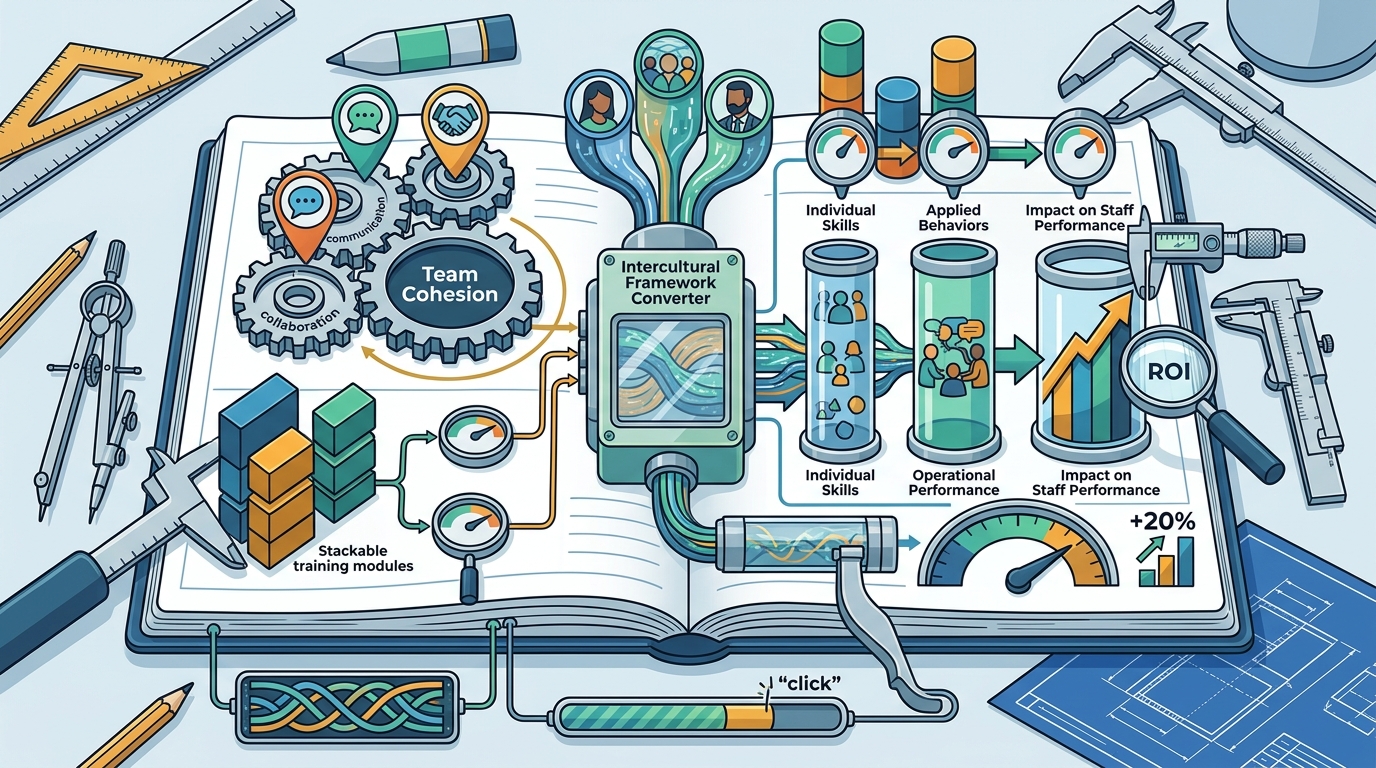
Calculating the Return on Inclusion
Ultimately, stakeholders require a financial justification for intercultural training. Return on Inclusion (ROI) is the financial benefit derived from diversity initiatives relative to the cost of implementation. While some benefits are qualitative, many can be quantified through standard business metrics.
Key financial indicators include reduced turnover costs, increased innovation revenue, and improved client retention. For example, if training reduces turnover by 10%, calculate the savings based on average recruitment and onboarding costs. Similarly, track the performance of diverse teams on innovation projects. Research consistently shows that diverse teams outperform homogeneous ones in problem-solving tasks.
We also assess the impact of grant impact on social cohesion for organizations receiving external funding. This ensures that public or private grants are delivering measurable community and organizational benefits. Our team, including Amiel Nubaha, brings expertise in restorative justice and community cohesion to these assessments.
ROI Calculation Framework:
| Metric | Pre-Training Baseline | Post-Training Result | Financial Impact |
|---|---|---|---|
| Employee Turnover Rate | 15% | 12% | $120,000 Saved |
| Team Conflict Incidents | 20/month | 10/month | 100 Hours Saved |
| Client Retention Rate | 85% | 92% | $250,000 Revenue |
This structured approach provides a clear narrative of value. According to a 2025 analysis by McKinsey & Company on diversity and inclusion, companies in the top quartile for ethnic diversity are 36% more likely to outperform on profitability. This data reinforces the business case for rigorous impact evaluation.
Key Takeaways
- Baseline Data is Critical: You cannot measure change without a clear starting point established through diagnostic surveys.
- Behavior Over Theory: Focus on observable behavioral metrics rather than just knowledge retention.
- Continuous Feedback: Implement real-time feedback loops to sustain momentum and address gaps immediately.
- Policy Alignment: Ensure organizational policies support and reinforce training principles.
- Quantifiable ROI: Track turnover, innovation, and client retention to demonstrate financial value.
- Expert Guidance: Utilize specialized consultants like those at Mosaic Intercultural Solutions for accurate assessment.
- Community Codesign: Involve stakeholders in the evaluation process to ensure relevance and buy-in.
Frequently Asked Questions
How long does it take to see results from intercultural training?
Initial behavioral changes can be observed within three to six months. However, significant cultural shifts and measurable ROI typically require 12 to 18 months of consistent effort and reinforcement.
What is the best tool for measuring intercultural competence?
There is no single best tool. A combination of self-assessment surveys, 360-degree feedback, and behavioral observation is most effective. Tools like the DiversityInc assessment frameworks are often used in conjunction with custom organizational metrics.
Can small businesses afford to measure intercultural training impact?
Yes. Small businesses can use low-cost pulse surveys and simple turnover tracking. The cost of not measuring is higher, as unchecked cultural issues can lead to talent loss and reputational damage.
How do I handle resistance to diversity metrics?
Frame metrics in terms of organizational health and performance rather than political ideology. Use data to show how inclusive practices improve team efficiency and client satisfaction.
What role does leadership play in measuring impact?
Leadership must model the behaviors being measured and allocate resources for ongoing assessment. Without executive sponsorship, measurement efforts often lack the necessary authority and scope.
Is external consulting necessary for impact evaluation?
While internal teams can conduct basic evaluations, external consultants provide objectivity and specialized expertise. Firms like Mosaic Intercultural Solutions offer specialized mediation and cohesion expertise that enhances accuracy.
How often should intercultural training be refreshed?
Training should be refreshed annually, with continuous micro-learning integrated into daily workflows. Regular updates ensure that content remains relevant to evolving demographic and social contexts.
Start Your Evaluation Journey
Evaluating the impact of intercultural training is not just a compliance exercise. It is a strategic imperative that drives performance, innovation, and cohesion. By implementing the frameworks outlined above, you can transform abstract diversity goals into tangible business results. Do not leave your organization's cultural health to chance.
Contact Mosaic Intercultural Solutions today to schedule a diagnostic baseline assessment. Our team of experts is ready to help you build a connected, high-performing workplace. Visit our Let's Talk page to begin the conversation.